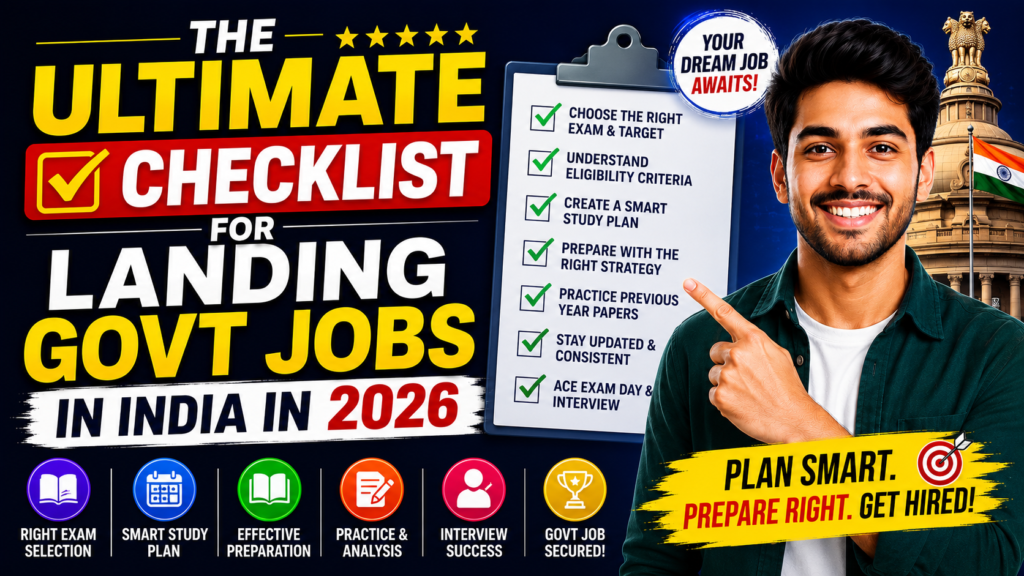
THE ULTIMATE CHECKLIST FOR LANDING GOVT JOBS IN INDIA IN 2026
Every serious aspirant needs a reliable checklist for landing govt jobs in India — not because the process is complicated, but because missing even one step can disqualify your application before it is ever read. This guide gives you that checklist, phase by phase, from the moment a notification is published to exam day itself.
Bookmark this page. Whether you are preparing for UPSC, SSC, IBPS, or RRB in 2026, this checklist for landing govt jobs in India will serve as your preparation backbone.
TABLE OF CONTENTS
- Why Government Jobs Still Dominate Career Aspirations in India
- Phase 1: Before the Notification
→ Know Your Target Exam Category
→ Confirm Your Eligibility - Phase 2: Registration and Documentation
- Phase 3: Study Strategy and Preparation
→ Understand the Syllabus Completely
→ Previous Year Papers Are Your Bible
→ Build a Realistic Study Timetable - Phase 4: Mock Tests and Revision
- Phase 5: Exam Day Checklist
- Resources Worth Using
- Final Thoughts
WHY GOVERNMENT JOBS STILL DOMINATE CAREER ASPIRATIONS IN INDIA
Job security, pension benefits, healthcare, housing allowances, and social respect — the appeal of a central or state government job in India has not diminished in 2026. UPSC, SSC, IBPS, RRB, and state PSC exams collectively attract tens of millions of applicants annually. The competition is fierce, but the preparation is learnable.
PHASE 1: BEFORE THE NOTIFICATION
Know Your Target Exam Category
- Group A (IAS, IPS, IFS) — UPSC Civil Services, requires 12–18 months of dedicated prep
- Group B (SSC CGL, CHSL) — central government clerical and executive roles
- Banking (IBPS PO, SBI Clerk) — bank probationary officers and clerks
- Railways (RRB NTPC, ALP) — technical and non-technical railway posts
- State PSC Exams — each state has its own civil services examination
- Defence (NDA, CDS, AFCAT) — armed forces commissioned officer roles
Confirm Your Eligibility
Every notification specifies age limits, educational qualifications, and domicile requirements. Check these carefully before investing preparation time. Age relaxation rules for SC/ST/OBC/PwD candidates vary by exam and must be verified at the official UPSC website (https://upsc.gov.in) or SSC portal (https://ssc.nic.in) directly from the notification.
PHASE 2: REGISTRATION AND DOCUMENTATION
This phase is where many aspirants lose marks — not in the exam hall but at the application stage. No checklist for landing govt jobs in India is complete without covering documentation carefully.
- Create one dedicated email address for all exam registrations
- Keep a scanned copy of Class 10 certificate (for date of birth proof)
- Graduation certificate or marksheets (for degree-level exams)
- Caste certificate if claiming reservation (must be in prescribed format)
- Income certificate for EWS category if applicable
- Passport-size photograph in the specified format (usually white background)
- Signature scanned at specified resolution and file size
- Valid identity proof (Aadhaar is accepted by most boards)
PHASE 3: STUDY STRATEGY AND PREPARATION
Most government exam failures are not due to lack of intelligence — they are due to lack of structure. This is the core of any serious checklist for landing govt jobs in India.
Understand the Syllabus Completely
Download the official syllabus directly from the exam board’s website. Do not rely on coaching institute materials alone — they sometimes include outdated topics. Cross-reference with previous year question papers to understand what is actually asked vs what is merely listed.
Previous Year Papers Are Your Bible
Solve at least 10 years of previous papers for any major exam. This tells you pattern, difficulty level, repeated topics, and time management requirements better than any textbook. Start solving these from day one of your preparation — not just in the weeks before the exam.
Build a Realistic Study Timetable
6 to 8 hours of focused study per day is a realistic target for serious UPSC aspirants. For SSC or IBPS, 3 to 5 hours is sufficient if started at least 6 months before the exam. Schedule topic-wise revision days and mock test days explicitly — do not leave these to chance.
PHASE 4: MOCK TESTS AND REVISION
- Take at least 2 full mock tests per week in the final 2 months
- Analyse every wrong answer — do not just check the score
- Revise your notes, not textbooks, in the final 3 weeks
- Stop learning new topics 10 days before the exam
- Practice previous papers under strictly timed conditions
PHASE 5: EXAM DAY CHECKLIST
- Admit card downloaded and printed (carry 2 copies)
- Original ID proof matching the registration form
- Reach the venue at least 45 minutes early
- Carry only permitted stationery (check exam rules carefully)
- No mobile phones, smartwatches, or electronic devices
- Wear comfortable clothing — some exam halls have poor ventilation
RESOURCES WORTH USING
NPTEL (https://nptel.ac.in) offers free courses relevant to technical government exams. Vision IAS or Drishti IAS are reliable for UPSC current affairs. Testbook and Adda247 are trusted for SSC and Banking mock tests. Always cross-check notifications at the official exam board websites.
FINAL THOUGHTS
This checklist for landing govt jobs in India is a starting point, not a guarantee. The candidates who succeed are the ones who show up consistently, adjust their strategy after every mock test, and stay patient through a long preparation cycle. The process is hard. The result is absolutely worth it.